
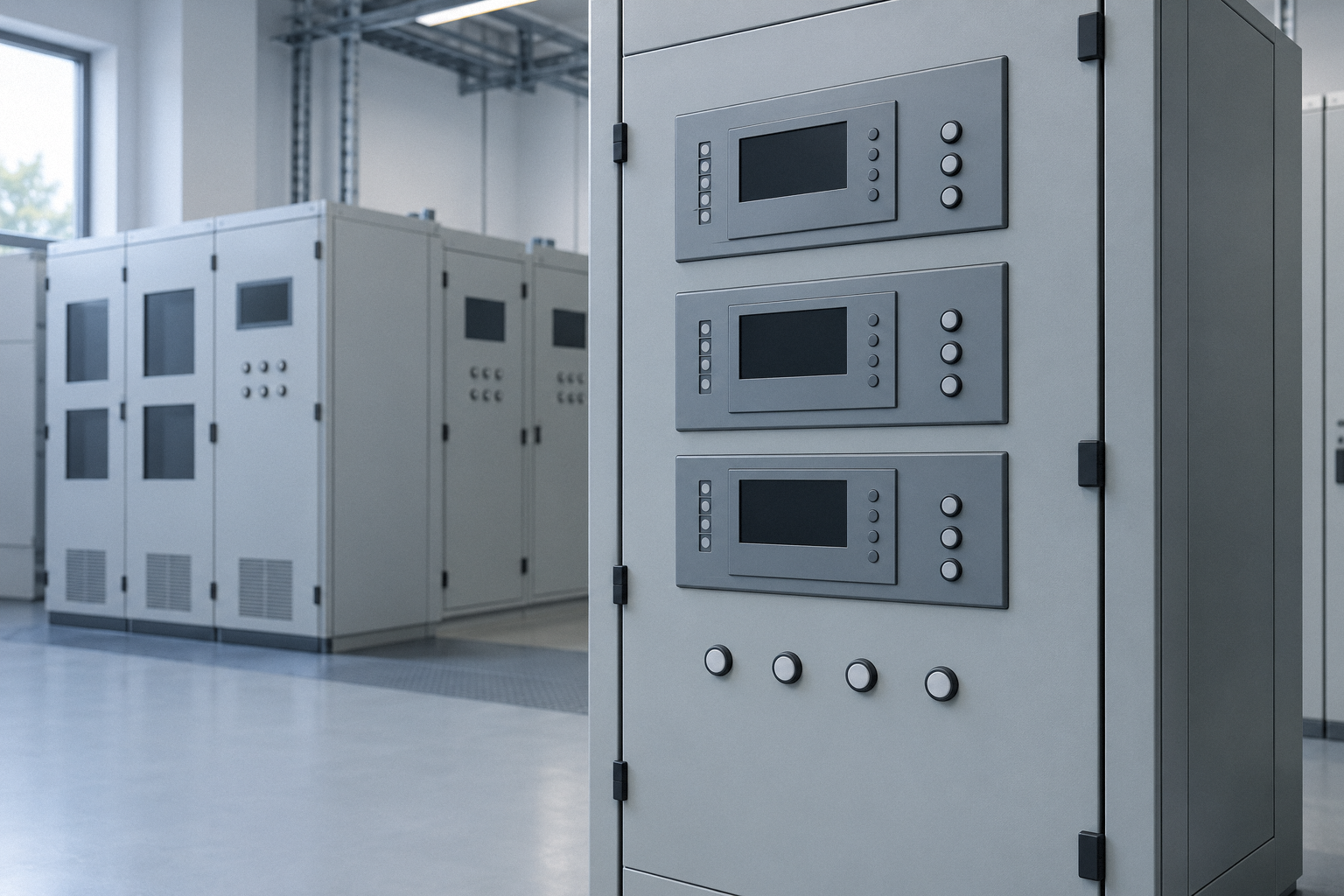
Power-system protection uses measurements and protective devices to respond to electrical faults and other abnormal conditions. Its purpose is to help limit the consequences for equipment and the wider system. The protection available at a particular installation depends on its design.
How do measurements reach protection equipment?
A protective relay needs information about the circuit it supervises. The National Instructional Media Institute (NIMI) describes a protection current transformer that provides a secondary current to a relay. It also describes voltage transformers supplying measuring instruments and protective relays. These measurements are inputs to the protection scheme; the choice of devices and connections depends on the application.
What happens when a fault is detected?
The measuring transformers provide inputs; the protective relay evaluates the information for the function it is designed to perform. A relay can initiate a circuit-breaker trip through the protection and control arrangement. The breaker is the switching device that opens the circuit. Which breaker operates, and which equipment loses supply, depend on the scheme and the location and nature of the fault. Protection reduces risk; it cannot promise that every disturbance will be contained without damage or interruption.
For examples of fault types and their effects, see Faults in Power Systems.
What can a control and relay panel show?
NIMI lists meters, indicating lamps and annunciators among the equipment that can be fitted to a control and relay panel. They help present measurements and indications to personnel; their presence and purpose depend on the panel design. An indication is information about the system, while a trip command initiates a switching action. The two should not be assumed to mean the same thing.
Are all protection schemes alike?
No. Protection must suit the equipment and circuits being supervised. NIMI describes control and relay panels used with equipment such as transformers, generators, lines and busbars, and notes that panels are supplied in different configurations. Relays, indicators and other components are selected for the design.
One example is differential protection. In its 7SR242 transformer-protection manual, Siemens describes a biased differential function that compares winding currents. The manual also identifies the effects of an on-load tap changer as a possible source of steady-state error considered in the relay characteristic. This is an example from one relay, not a general setting or a complete description of transformer protection.
Safety and further reading
Protection equipment does not make energized apparatus safe to approach or work on. Setting, testing and maintaining protection systems require qualified personnel, approved procedures and the documentation for the actual installation. This introduction does not provide settings, wiring or switching instructions.
Sources: NIMI, Electrician (Power Distribution), 2nd Year Trade Theory, PDF pages 67, 181, 326 and 329; Siemens 7SR242 Duobias technical manual, PDF page 34.