

Why a multiplier may be needed
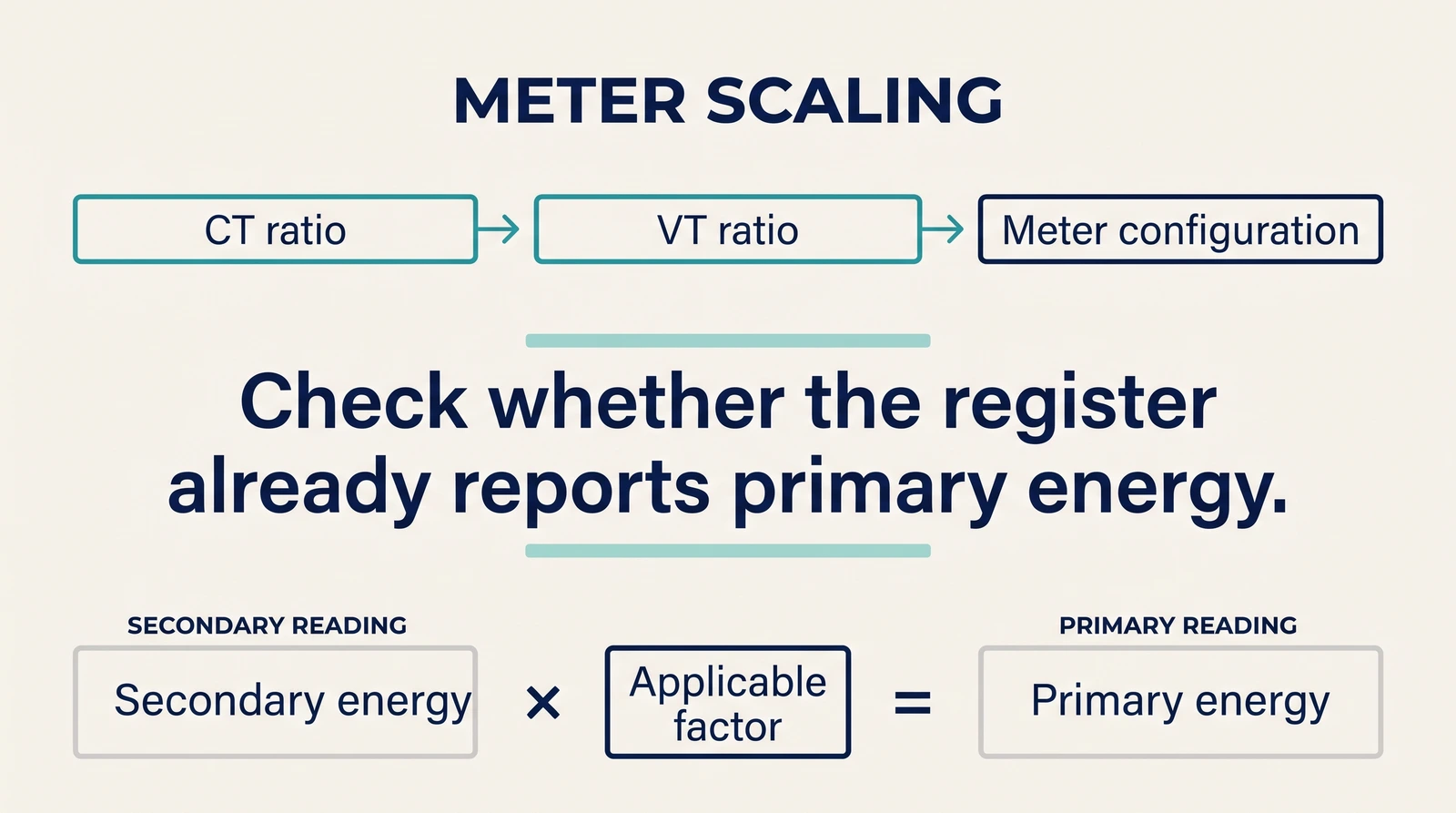
Instrument transformers provide scaled representations of primary current and voltage to a meter. Whether the displayed reading already accounts for their ratios depends on the meter configuration and the metering scheme.
Using instrument transformer ratios
A current transformer represents primary current at a lower secondary level; a voltage transformer similarly provides a scaled voltage. Their ratios must come from the installed equipment and documentation, with units and connections understood.
Avoiding double scaling
The correct factor depends on the meter, its configured ratio and the billing or reporting method. Verify the complete scheme before using a factor; a partially specified example cannot establish a reliable final result.
A complete hypothetical example
Suppose a meter displays 10 kWh measured on its secondary inputs and has not been programmed to apply transformer ratios. If the CT is 200:5, its ratio is 40. If the voltage transformer is 2,400:120, its ratio is 20. Under those stated assumptions the combined ratio is 40 × 20 = 800, and the primary-side energy corresponding to the displayed interval is 10 × 800 = 8,000 kWh.
When not to multiply again
The example illustrates the arithmetic and is not a setting recommendation. If a meter is configured to apply both ratios and its register already represents primary energy, multiplying the register by 800 again would double-count the scaling. Some billing systems use their own factors; confirm exactly what each register represents.
Read the whole metering scheme
Check primary and secondary nameplate values, whether they refer to the same voltage basis, the meter programming, and any separate billing multiplier. A test record or meter manual can identify whether a value is a raw secondary quantity or an already-scaled primary quantity. All inputs must be established for the actual installation.
Units and register boundaries
A meter reading can be cumulative rather than the energy used during one period. For a billed interval, the difference between appropriate beginning and ending readings is the relevant starting quantity, subject to the meter and billing rules. Confirm that both readings are from the same register and that units have not changed before applying any required factor.
Further reading
Bharat Skills Electrician (Power Distribution), revised 2022, pp. 48–49 and 163–171.