

Purpose
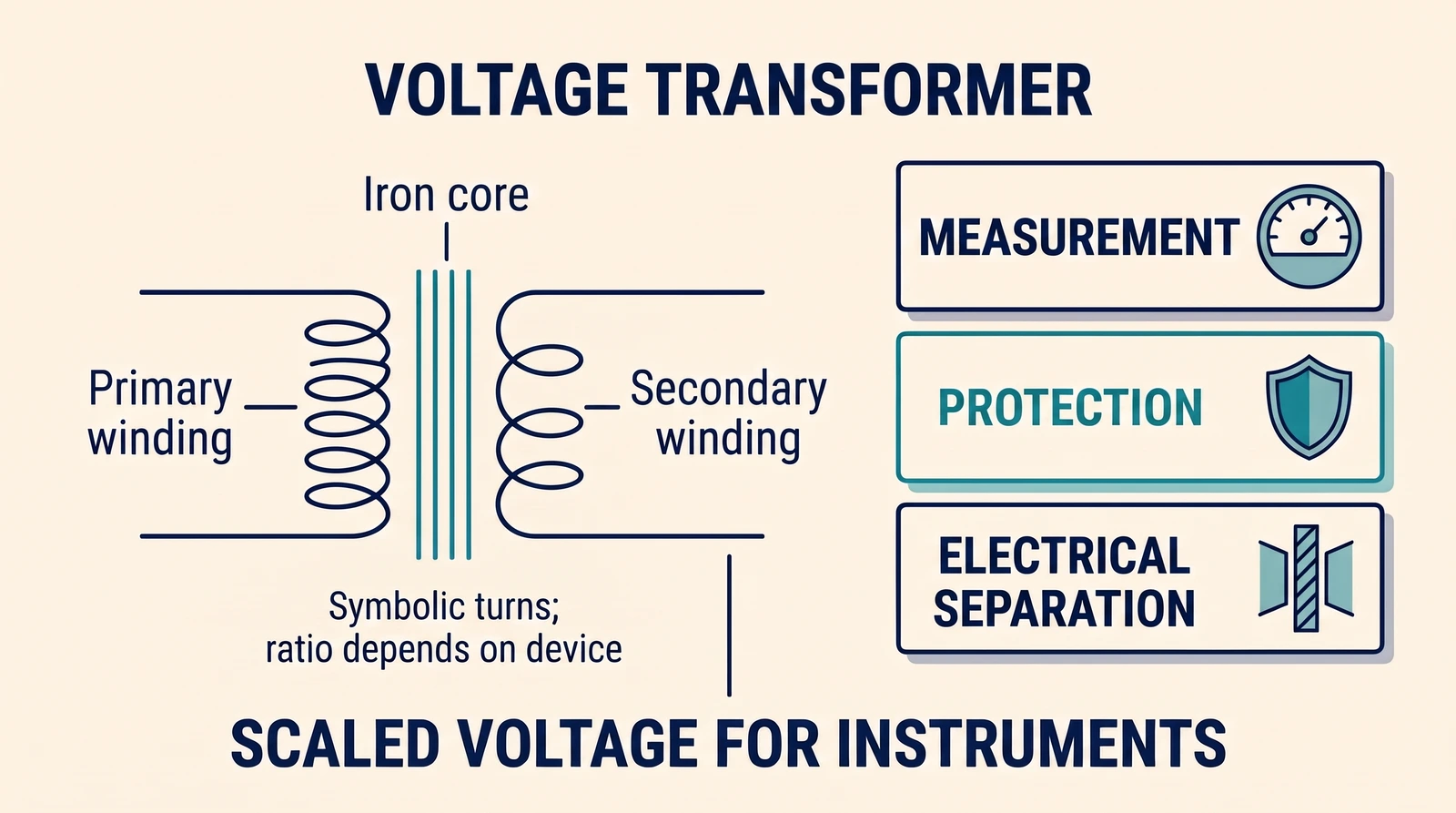
A potential transformer, also called a voltage transformer, provides a scaled voltage for measurement and protection. Its primary and secondary ratings must be read from the particular device; no single secondary value applies to every installation.
Electromagnetic and capacitive types
An electromagnetic voltage transformer uses induction between windings. The cited training text also describes capacitive voltage transformer arrangements. Their construction and application differ, so they should not be treated as identical devices.
Use with instruments
The transformer and its connected instruments form a measurement circuit. Accuracy and burden are relevant to the intended application. For selection, connection or testing, use the applicable device documentation and qualified personnel.
Ratio in context
A transformer’s marked ratio describes its intended primary and secondary voltages under specified conditions. For example, the training source uses 11 kV and 110 V as an example, not as a universal required secondary value. The voltage basis and connected instrument must be understood before applying a ratio.
Measuring and protecting
A voltage transformer supplies a representation of system voltage to instruments or protective functions. The correct accuracy and burden requirements depend on the application. A metering instrument and a protection relay do not necessarily impose identical requirements.
Construction differs by type
An electromagnetic device uses windings coupled by a magnetic circuit; a capacitive arrangement uses a divider as part of its voltage-reduction method. Physical construction and documentation differ. Neither generic description establishes the terminals, ratings or service conditions of a particular unit.
Ratios and secondary instruments
When comparing a measured secondary voltage with the system quantity, the instrument ratio and measurement basis must be known. Confusing line-to-line and line-to-neutral values, or combining a configured meter ratio with an extra factor, can produce a misleading result. The correct calculation depends on the actual connection and instrument configuration.
Further reading
Bharat Skills Electrician (Power Distribution), revised 2022, pp. 169–171.