
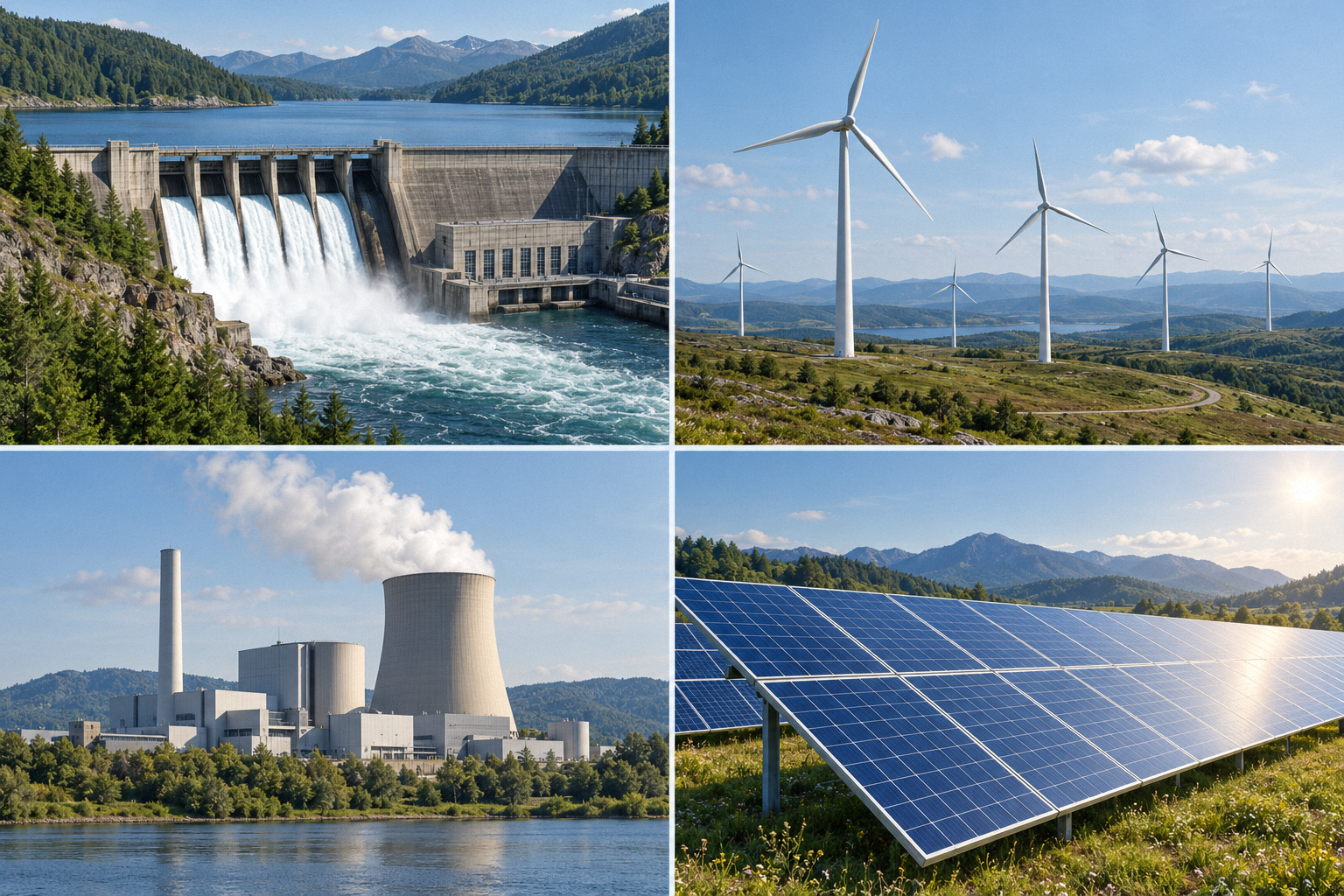
Hydroelectric, wind, steam-turbine and solar photovoltaic installations are four examples of ways to produce electricity. They are not a complete list, and they are not four wholly different conversion mechanisms. The first three use moving machinery to drive a generator; photovoltaic cells convert light directly into electricity.
1. Hydroelectric generation
In a hydroelectric plant, moving water transfers energy to a turbine. The turbine shaft drives an alternator, which converts that mechanical energy into electricity. In the example described by the NIMI training text, water is led from a reservoir to a turbine; the energy available depends on the flow and the height difference that moves the water.
The water is the energy source, while the turbine and alternator perform separate steps in the conversion. A plant's arrangement depends on its water resource and design, so a reservoir should not be assumed for every hydroelectric installation.
2. Wind generation
Wind carries kinetic energy. When it moves a turbine's blades, their rotation provides mechanical energy to drive an electrical generator. NIMI describes an example in which a gearbox connects the rotor to the generator; equipment arrangements differ between turbine designs.
Wind speed changes, so the mechanical input is not constant. Electrical equipment can condition the generator's output for its intended use. This is a different energy source from moving water, although both examples use rotating machinery and a generator.
3. Steam-turbine generation
A steam-turbine plant uses heat to produce steam. The steam drives a turbine, and the turbine drives a generator. The conversion chain therefore has an intermediate thermal step before mechanical rotation produces electricity.
The heat can come from different sources. NIMI describes fuel combustion and nuclear fission as examples that can provide heat for steam generation. Those are distinct sources of energy, even when the downstream turbine and generator perform a similar role. A steam turbine describes part of the conversion process rather than the fuel or other primary source itself.
4. Solar photovoltaic generation
Photovoltaic cells use semiconductor materials to convert energy from light into electrical energy. NIMI describes sunlight exciting electrons in the cell and creating an electrical potential. Cells can be connected to form a module, and modules can form a larger system.
Unlike the three examples above, the photovoltaic cell does not need a turbine or rotating generator to produce electricity. Other components may still be needed: for example, an inverter can convert the system's DC output to AC for an intended application.
Why are there other possible answers?
A list can group electricity production by its energy source, its conversion equipment or the type of plant. The NIMI text lists sun, wind, water, fuels, nuclear energy and tides among energy sources. Different sources can drive similar generators, and one source can be used through different technologies. These four examples illustrate conversion paths rather than a complete classification.
Source: NIMI, Electrician (Power Distribution), 2nd Year Theory, PDF pages 34, 45, 57 and 61.