
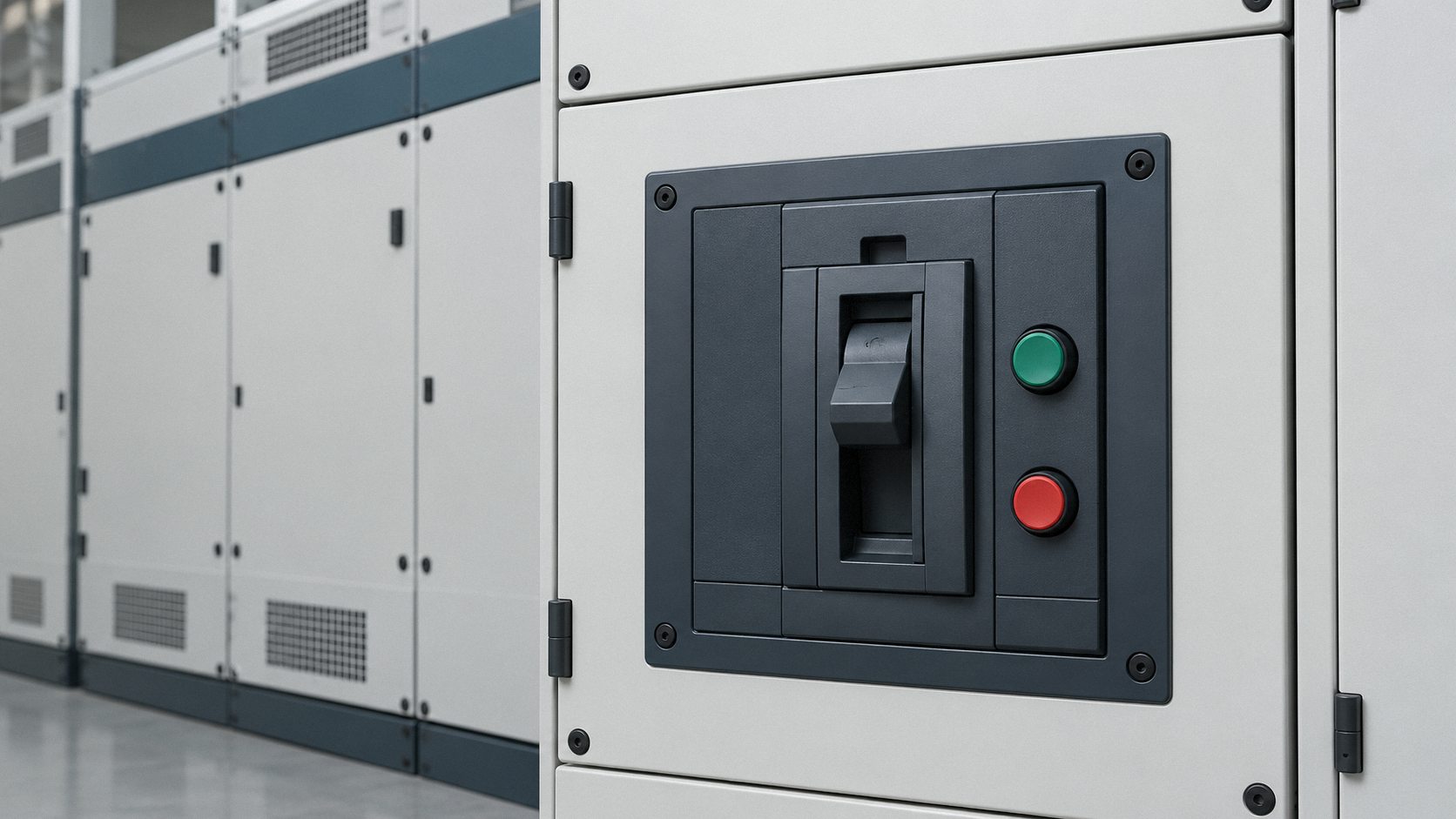
An anti-pumping function prevents a circuit breaker from repeatedly closing and opening in response to one continuous closing command. The function is often called an anti-pumping relay, although it can be built into the breaker mechanism or implemented in control logic instead of a separate relay.
Why a breaker might “pump”
A circuit breaker connects or disconnects a circuit using moving contacts. A CLOSE command asks the breaker to connect the circuit; an OPEN or TRIP command asks it to disconnect. A protective relay can issue a trip when it detects an abnormal condition. A control switch, remote controller, or another device can issue a close command.
If a close command stays on while an opening or tripping command is also present, an uncontrolled closing circuit could try to close again each time the breaker opens. This repeated operation is called pumping. It can subject the breaker and the electrical system to unnecessary mechanical and electrical stress.
How anti-pumping works
The anti-pumping function recognizes that the same close request is still present and blocks another closing attempt. In a common arrangement, a relay and its contacts hold a blocking state until the close signal is removed. Once the signal has been released, the function can reset and a new close request can be considered. Resetting the anti-pumping function does not itself order the breaker to close: other conditions, including any active trip, lockout, or interlock, must also permit closing.
The exact sequence depends on the equipment. Siemens describes its SION 3AE6 breaker as performing an OPEN–CLOSE–OPEN or CLOSE–OPEN sequence when constant electrical CLOSE and OPEN commands are present together. The closing signal must then be briefly interrupted before a new CLOSE command is given. The same catalog describes a trip-free mechanism: an opening command after closing begins returns the contacts to open even if the closing command continues, although the contacts may momentarily close. See Siemens SION 3AE6 catalog, pages 5–6.
An example of a held close command
Imagine a remote CLOSE signal remains on while the breaker receives an OPEN command. In Schneider Electric's Masterpact MTZ, the manufacturer states that opening takes priority. With maintained opening and closing orders, its standard mechanism blocks the main contacts in the open position. After an overcurrent trip or intentional opening, the closing order must be discontinued and then reactivated for another close. This is an example of that product's behavior, not a sequence to assume for every breaker. See Schneider Electric's Masterpact MTZ controlling accessories catalog.
Does it have to be a separate relay?
No. Depending on the design, the function may be incorporated into the breaker mechanism or its control circuit. A relay and auxiliary contacts are one possible arrangement. The name describes the purpose, not a universal arrangement of terminals or components.
Anti-pumping and automatic reclosing
Automatic reclosing is a separate, deliberate control function. For example, an overhead-line scheme may issue a new close command after a trip and a prescribed delay when a temporary fault might have cleared. Anti-pumping limits repeated attempts caused by a sustained close command; it does not inherently prohibit a properly coordinated automatic reclosing sequence. The scheme must be designed so its commands, reset conditions, protection, and any lockout work together.
What the function does not do
Anti-pumping does not find or remove a fault, and it does not replace protective relays, trip-free operation, interlocking, or a lockout scheme. Releasing a close command does not establish that the circuit is safe to energize. Breaker designs and control schemes differ, so this explanation is not a wiring diagram or a set of operating settings. Qualified personnel should use the specific equipment documentation and approved operating procedures.