
The functions of an excitation system are
to provide direct current to the synchronous generator field winding, and
to perform control and protective functions essential to the satisfactory operation of the power system
The performance requirements of the excitation system are determined by
a)Generator considerations:
-supply and adjust field current as the generator output varies within its continuous capability
-respond to transient disturbances with field forcing consistent with the generator’s short-term capabilities:
-rotor insulation failure due to high field voltage
-rotor heating due to high field current
-stator heating due to high VAR loading
-heating due to excess flux (volts/Hz)
b)Power system considerations:
-contribute to effective control of system voltage and improvement of system stability
Elements of an Excitation System
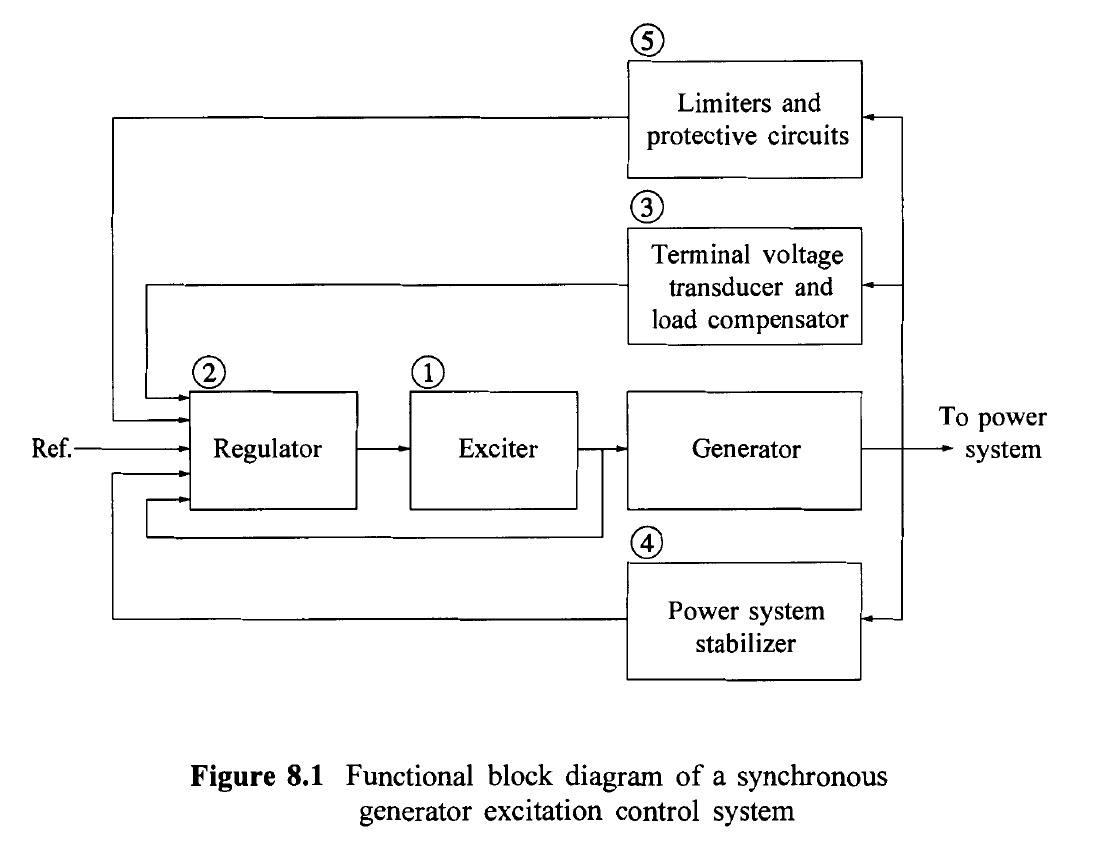
Exciter: It provides dc power to the generator field winding
Regulator: It processes and amplifies input control signals to a level and form appropriate for control of the exciter
Terminal voltage transducer and load compensator: It senses generator terminal voltage, rectifies and filters it to dc quantity, and compares it with a reference; load comp may be provided if desired to hold the voltage at a remote point
Power system stabilizer: It provides an additional input signal to the regulator to damp power system oscillations
Limiters and protective circuits: To ensure that the capability limits of the exciter and generator are not exceeded