
Why supervise the trip circuit
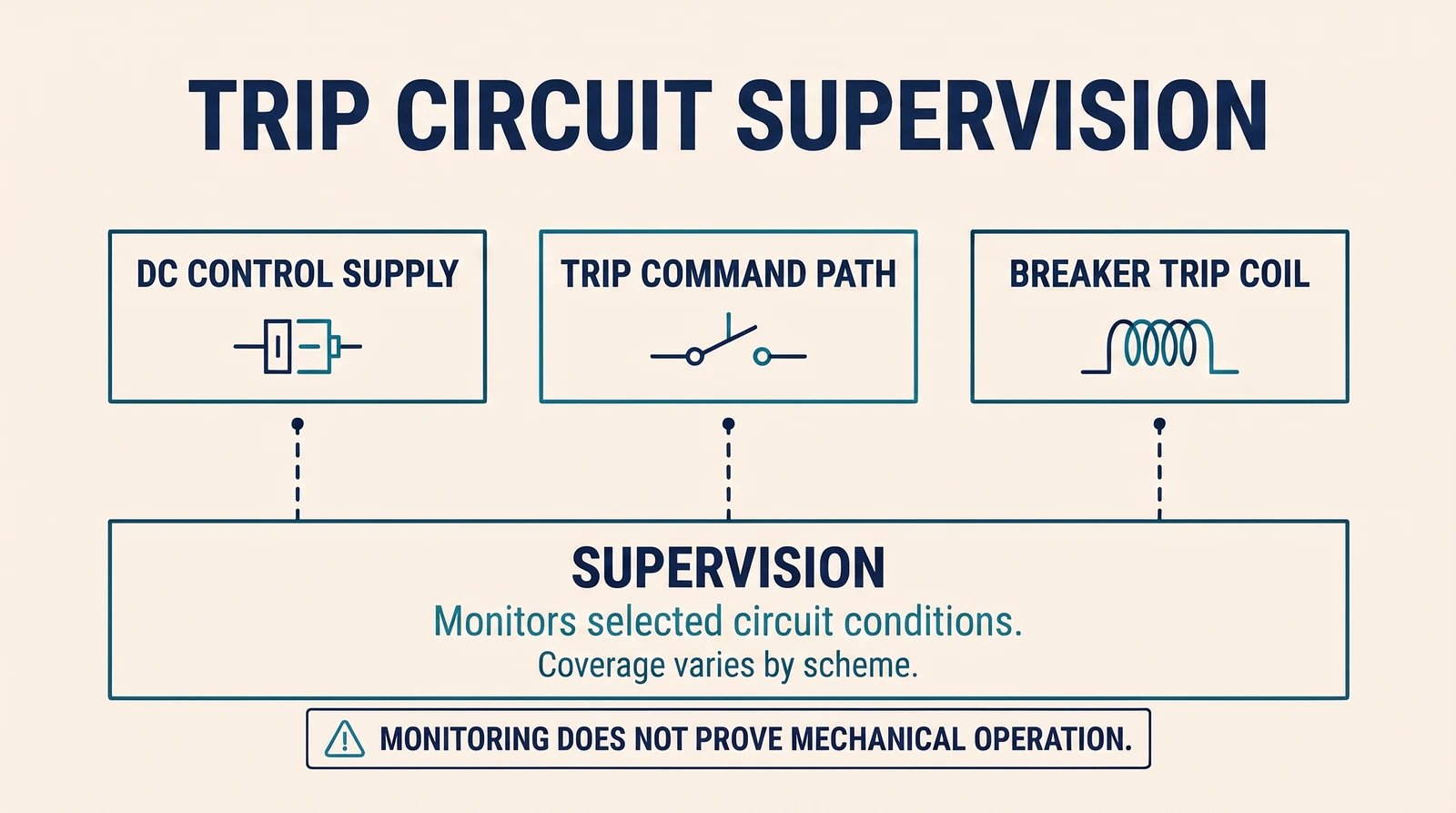
A protection system needs a working path from its trip command to the circuit breaker. Trip circuit supervision monitors parts of that path and can report an abnormal condition that might otherwise remain unnoticed.
What a relay monitors
The Siemens 7UT6x manual describes a supervision function using one or two binary inputs, depending on the implementation. What is monitored depends on the breaker contacts, control supply and wiring used for the particular installation.
Interpreting an alarm
A supervision alarm identifies a condition requiring investigation; it does not by itself identify a failed component or prove the breaker will trip. Refer to the actual schematic, relay manual and site procedures. This overview is not a wiring diagram.
Breaker closed and open
Monitoring arrangements can account for both breaker positions. In the cited Siemens two-input example, the relay evaluates different input states when the breaker is closed and when it is open, using auxiliary-contact information. The exact coverage depends on the arrangement; a single-input implementation has different design details.
Transient versus persistent conditions
The manufacturer’s example checks the input states repeatedly and delays an alarm so that a normal short transition during a trip is not treated as a persistent defect. An interrupted trip circuit, a short circuit or loss of the control supply can produce a monitored abnormal state in that implementation. Other schemes may use different criteria.
What supervision cannot establish
Supervision of electrical continuity is not proof that every mechanical part of a breaker will operate, nor that all protection settings are correct. An alarm needs evaluation alongside breaker state, event records and the installation drawings. A healthy indication should not replace the facility’s maintenance and functional-test program.
Reading a drawing
A specific circuit drawing identifies the control supply, trip contact, breaker auxiliary contacts and trip coil, as well as monitored and unmonitored sections. This article deliberately does not prescribe connection points, resistor values or a repair sequence.
Supervision and protection
The trip circuit is the command path by which a protective device asks a breaker to open. Supervision examines selected electrical conditions in that path; the protective relay’s decision to issue a trip is a separate function. Both must work as intended for the complete protection system to clear a fault.