
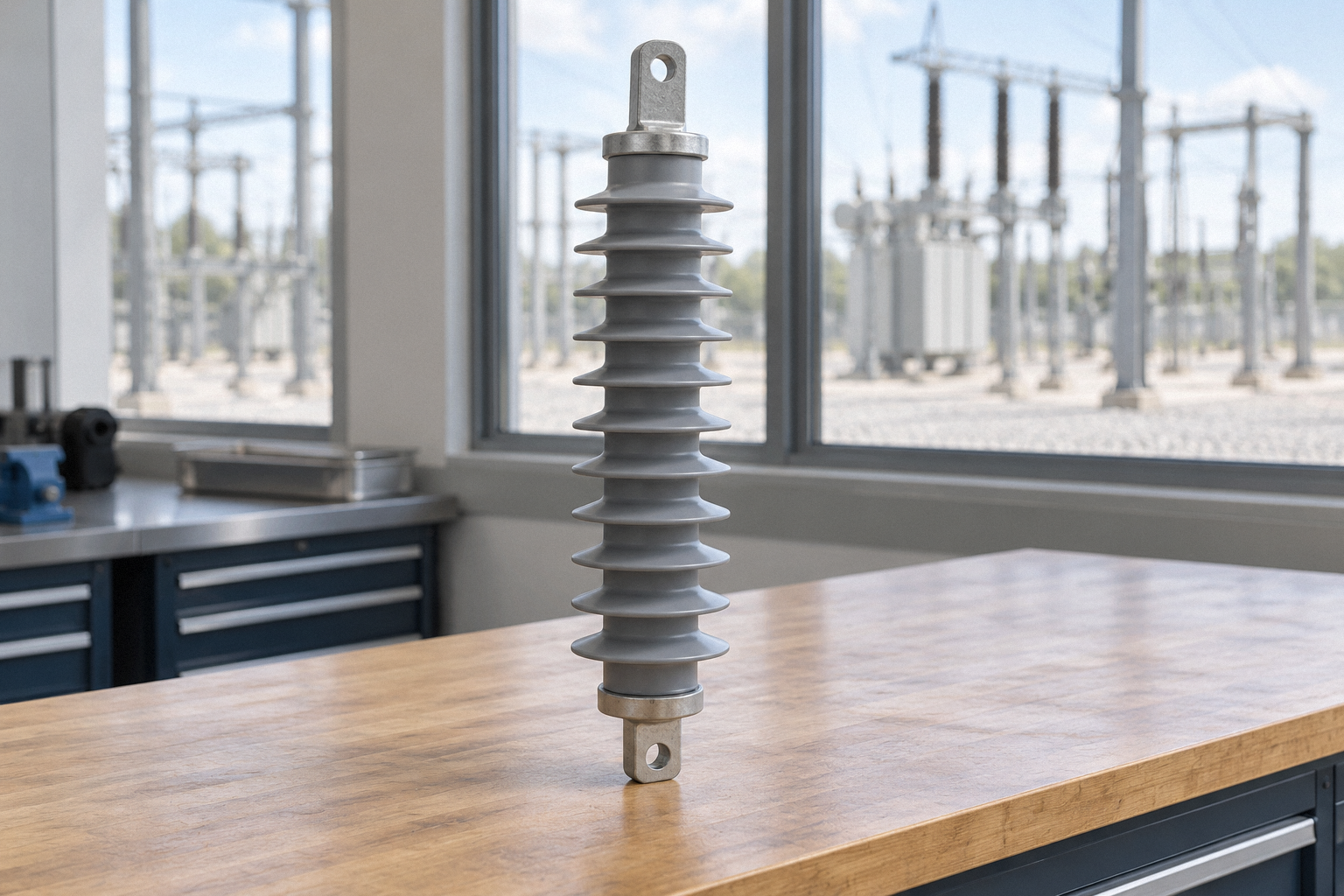
A surge arrester helps protect electrical equipment from brief overvoltages. Substations use these devices as part of a broader protection design; the choice and placement of an arrester depend on the equipment and the electrical system.
What is a surge?
A voltage surge is a brief overvoltage. The NIMI power-distribution training material describes lightning surges and switching surges as events relevant to arrester protection. The severity and effect of a surge depend on the circumstances and on the equipment exposed to it.
How does an arrester protect equipment?
During ordinary system operation, the device is designed to avoid carrying the normal power current to earth. When a surge occurs, it provides a path for surge current and helps limit the voltage imposed on connected equipment. Protection depends on the complete installation and does not mean that damage is impossible.
What is a metal-oxide surge arrester?
NIMI identifies metal-oxide resistors as components used in this type of arrester. The exact construction and performance must be established from the manufacturer's documentation for the particular device.
Is an arrester the same as a lightning rod?
No. A lightning rod or conductor is intended to protect a structure from lightning. A surge arrester in an electrical system is intended to limit a voltage surge affecting connected equipment. They perform different protective roles.
Where might an arrester be used?
NIMI describes arresters at substation entrances and near transformer terminals as examples. These examples are not a placement rule: a qualified designer must consider the system and equipment being protected, the manufacturer's requirements and applicable standards.
Safety and source
Substation equipment and its connections can present serious electrical hazards. This overview is not an installation, testing or maintenance procedure. Work on or near the equipment belongs to qualified personnel following the site procedures and the manufacturer's instructions.
Source: NIMI Electrician (Power Distribution), second-year theory, printed pages 49 and 76. The source supports general principles and examples; it does not establish the rating, wiring or condition of a particular arrester.